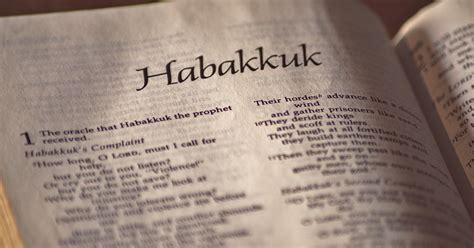
Habakkuk 1:1-11
Background: Habakkuk was a prophet under (good) King Josiah, 640-609bc. When King Josiah dies, the following king was not so good (Babylonia rises!). Interesting to me: Habakkuk 2:4 was what the Apostle Paul used in Romans 1:17 to introduce the justification by faith alone principle. Martin Luther’s interpretation of this verse totally reoriented his thinking and was a contributor to which the Protestant Reformation was based on. Hallelujah!
Citations, citations: This study’s title and the series outlines were originally preached from by Edwin Shepperson at Grace Church in September/October 2013. These Bible studies in this series are from my own notes (by the Spirit’s direction) upon hearing when the sermons were preached.
Habakkuk 1:1-11: New American Standard Bible (1995)
1 The oracle which Habakkuk the prophet saw.
2 How long, O Lord, will I call for help, and You will not hear? I cry out to You, “Violence!” yet You do not save.
3 Why do You make me see iniquity, and cause me to look on wickedness? Yes, destruction and violence are before me; strife exists and contention arises.
4 Therefore the law is ignored and justice is never upheld. For the wicked surround the righteous; Therefore justice comes out perverted.
5 “Look among the nations! Observe! Be astonished! Wonder!
Because I am doing something in your days—You would not believe if you were told.
6 “For behold, I am raising up the Chaldeans, that fierce and impetuous people who march throughout the earth To seize dwelling places which are not theirs.
7 “They are dreaded and feared; Their justice and authority originate with themselves.
8 “Their horses are swifter than leopards and keener than wolves in the evening. Their horsemen come galloping, Their horsemen come from afar; They fly like an eagle swooping down to devour.
9 “All of them come for violence. Their horde of faces moves forward. They collect captives like sand.
10 “They mock at kings and rulers are a laughing matter to them. They laugh at every fortress and heap up rubble to capture it.
11 “Then they will sweep through like the wind and pass on. But they will be held guilty, They whose strength is their god.”
Bad things are troublesome to people of faith.
1. Bad things and our whys. Verses 2-4
Everyone has had these moments, and wonders if He cares about us. It is OK to questions our ideas about God. (We Don’t Get What We Deserve – Worldwide Message Tribe, the song hits me right here)
2. Bad things and God’s work. Verses 5-11
Habakkuk’s gutsy rant is done (verses 1-4), and now it’s God’s reply. We may not always like what God is doing. In the time of Habakkuk’s writing, and even now, God used/uses badder people to correct bad people. Regardless of the when/how, He’s in control, always. It may be hard to understand, God is always at work, yet the world is still fallen and sinful. He often allows evil things to run their course, for His purposes we may never know, the why, prior to being in His presence in Heaven.
3. Bad things and our faith. Verse 5.
[above, the “and” is crossed out with “challenge” written over it]
“You would not believe it even if you were told” is incredible. Even though our God is Almighty: we are very limited. So we have to, must believe He’s doing good. That He loves us, He’s in control. He has a purpose in it, even if I cannot comprehend it or like it. Churchill is quoted as saying: “Never, never, never give up”. We should add to that/edit it to include: “never give up trusting Him”, as instructed in Proverbs 3:5-6.
4. Bad things and God’s grace. Romans 5:6-10
Grace is unearned favor. Grace is not intuitive: What is intuitive is that I either deserve or not deserve the bad happening. God suffered unjustly, He feels our pain, with us. Non-intuitive: Grace, suffering Jesus, He died for me. “God demonstrates His Love toward us, that while we were yet sinners, Christ died for us” (Romans 5:7).
Leave a Reply